WHEN CULTURE FINDS ITS VOICE | REINHARD “REINZ” AND THE MUSIC CARRYING NEW IRELAND TO THE WORLD
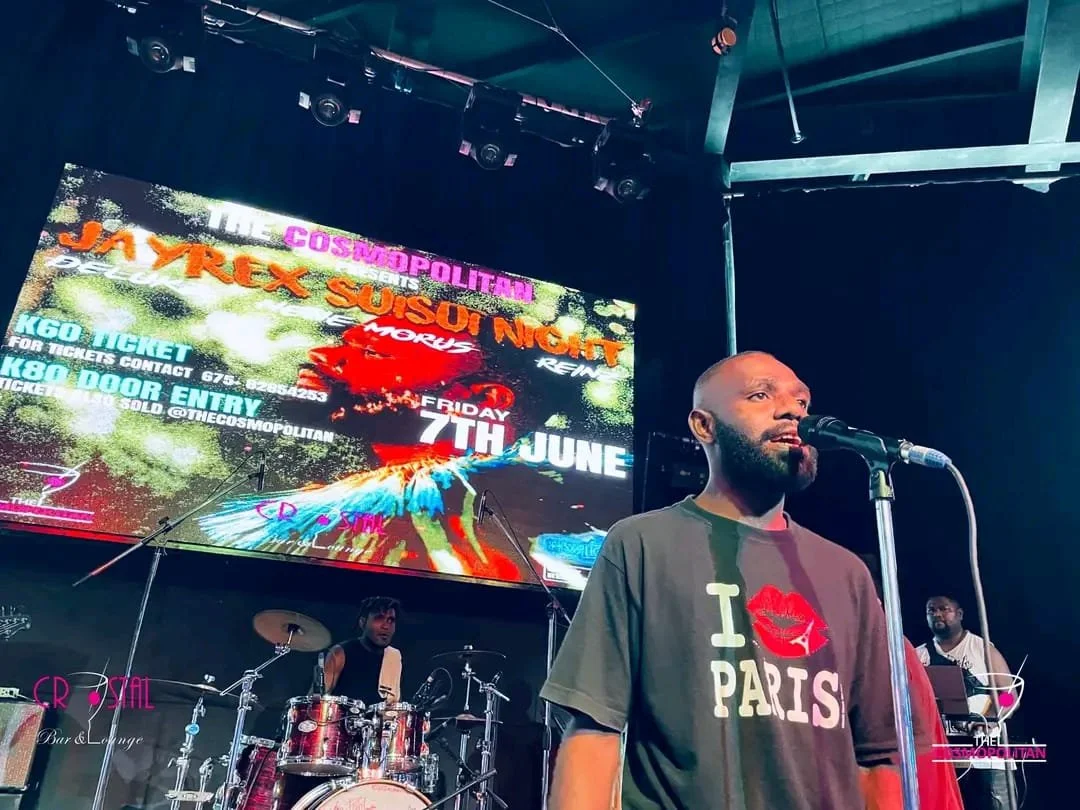
The future of music does not always arrive with neon lights and heavy bass.
Sometimes it arrives in a language older than the industry itself.
When Reinhard “Reinz” sings, he does not simply perform — he carries a piece of New Ireland with him. Every lyric in Tungag, the language of his people, pushes back against a world where smaller languages are slowly disappearing from everyday life.
In an era of globalized sound, that choice is more than artistic.
It is defiance.
Because in Papua New Guinea — a nation with more than 800 languages — every song written in a mother tongue is more than music. It is survival.
And Reinz understands that better than most.
THE VILLAGE BEFORE THE STAGE
Long before audiences, stages, or recordings, there was a boy growing up by the sea.
New Ireland is not a place that rushes. Life moves with the rhythm of tides, ceremonies, and community. Reinz’s childhood unfolded in a world where the beach was a playground, coconut trees were shelter, and the village itself was the center of everything.
“My playground was the beach and the shade of the coconut trees,” he says.
There was no sense that these surroundings were extraordinary.
But they were.
Because everything that would later shape his music already existed there — community, tradition, language, and the unspoken understanding that culture is not taught through books. It is lived.
The people around him carried that knowledge quietly: elders, families, fishermen, mothers, storytellers.
They were the first audience he ever had.
THE FIRST MUSIC WAS HUMAN
Before guitars, before studios, before modern beats — there were voices.
Reinz remembers nights filled with the sound of waves breaking against the shore and mornings punctuated by birds calling across the village.
But the sound that stayed with him most deeply was something else entirely.
The voices of elders singing together.
At funerals. At cultural gatherings. During community ceremonies.
No instruments. No microphones. Just layered voices carrying emotion, memory, and tradition across the night air.
Those moments were not performances.
They were cultural archives.
And without realizing it, Reinz was already listening like an artist.
WHEN MUSIC BECAME A CALLING
The turning point in Reinz’s journey did not arrive in a studio.
It arrived in a room full of people dancing.
Watching friends and family smile and move to his songs revealed something important to him — music had power.
Not the power of fame.
The power of pride.
“It wasn’t about being famous,” he explains. “It was about making people feel good and proud of their cultural heritage.”
That realization changed everything.
From that moment forward, music was no longer simply expression. It was responsibility.
TRADITION MEETS MODERN SOUND
Reinz belongs to a generation of artists navigating two worlds: the deeply traditional cultures of Papua New Guinea and the rapidly evolving global music scene.
Instead of choosing one over the other, he decided to merge them.
“Our young people love modern beats,” he says. “So I thought — why not put our own language on those beats?”
It is a simple idea, but a powerful one.
By writing and singing in Tungag, Reinz ensures that his music carries the sound of his ancestors into contemporary spaces.
“It’s like putting traditional oil on a new body,” he says with a smile. “It makes the culture look fresh again.”
What emerges is something rare: music that feels modern yet deeply rooted.
Songs that speak to both the village and the next generation.
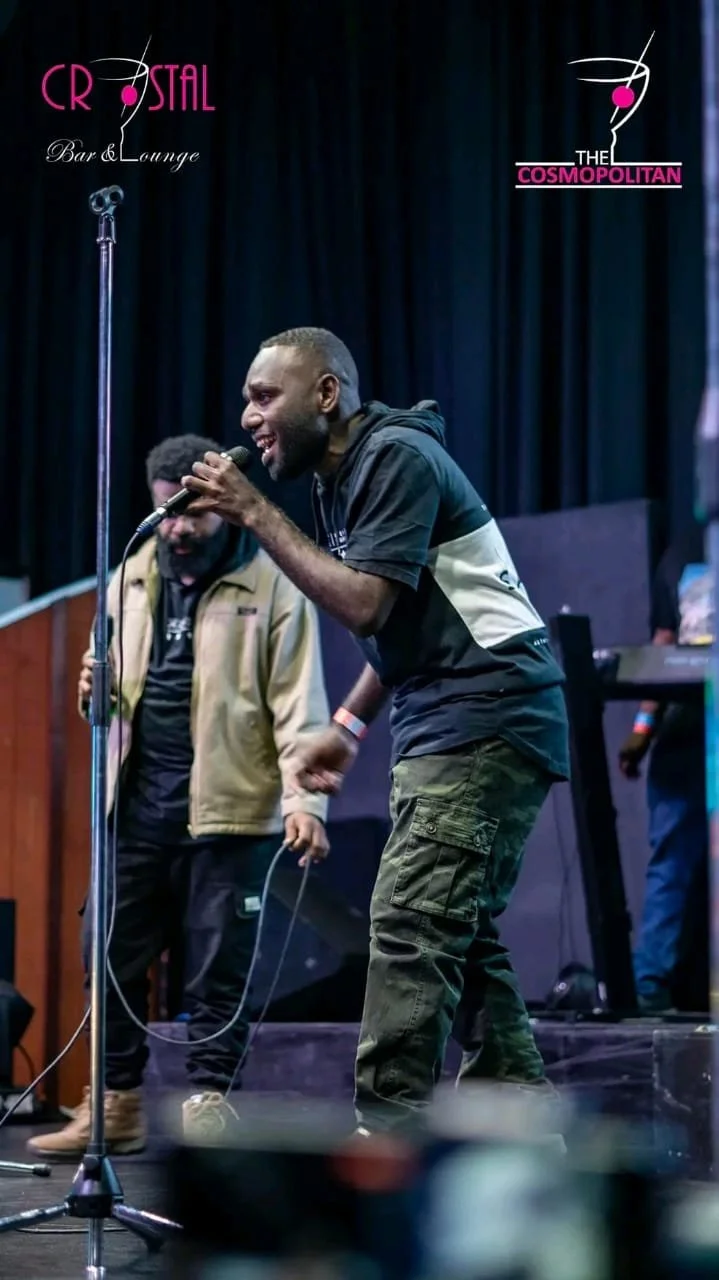
MUSIC AS CULTURAL MEMORY
Papua New Guinea is home to one of the most linguistically diverse populations on earth. Yet many languages are slowly fading as younger generations adopt global culture and technology.
For Reinz, music is one of the strongest tools to protect what might otherwise disappear.
“If we don’t sing our own songs, our culture might be lost forever.”
His songwriting draws inspiration from the ordinary beauty of village life: fishermen working the ocean, mothers caring for families, children growing up surrounded by tradition.
“These are beautiful stories,” he says.
And in Reinz’s music, those stories become permanent.
“A song is like a photo that you can hear.”
THE EDUCATOR AND THE ARTIST
Away from the stage, Reinz lives another life inside Papua New Guinea’s education system.
Working with the Department of Higher Education, Research, Science & Technology (DHERST), he helps coordinate overseas scholarships for Papua New Guinean students, connecting them with educational opportunities around the world.
At first glance, music and education might seem like separate paths.
But for Reinz, they are deeply connected.
“In my job, I help the mind,” he says. “In my music, I help the heart.”
Both, he believes, strengthen the future of the country.
THE RESPONSIBILITY OF REPRESENTATION
In Pacific cultures, music is rarely just entertainment.
It is identity.
Artists become ambassadors for their communities — voices that carry stories far beyond the village.
Reinz takes that responsibility seriously.
“When people listen to our music, they learn something about where we come from,” he explains.
That is why authenticity matters.
Every lyric, every story, every language choice becomes part of how the world sees Papua New Guinea.
THE BALANCE OF TWO WORLDS
Like many artists balancing work, family, and creativity, Reinz often finds himself creating music in the margins of everyday life.
Late nights. Quiet weekends. Moments stolen between responsibilities.
“The hardest part is finding the time,” he admits.
But passion has its own rhythm.
And when listeners tell him that his songs remind them of home, the effort becomes worthwhile.
INFLUENCES AND ROOTS
Reinz grew up listening to legendary Papua New Guinean artists who proudly sang about culture and identity.
Musicians such as Twinhox of Kavieng, Patti Potts Doii, Anslom Nakikus, Futlus Band, Justice Mokiniz, Charles Lamangau, Wali Hits, and Jayrex Suisui helped shape his understanding of what PNG music could be.
They proved something powerful: that local languages and traditional stories could thrive inside modern music.
Yet his greatest influence remains the same place where his journey began.
Home.
LOOKING FORWARD
As Papua New Guinea’s music industry continues to evolve, Reinz hopes to expand the reach of his work through collaborations with artists both locally and internationally.
His vision is not only about personal success.
It is about ensuring that PNG’s languages, traditions, and stories travel further than ever before.
Through music.
THE LEGACY OF A SONG
For Reinz, legacy is not measured in awards or fame.
It is measured in memory.
Years from now, he hopes listeners will hear something deeper inside his music — the language of a people, the rhythm of a village, the echo of stories passed down through generations.
“I want people to say that Reinz loved his culture and shared it through music,” he says.
And if those songs still carry the spirit of the village decades from now, then his mission will already have been accomplished.